

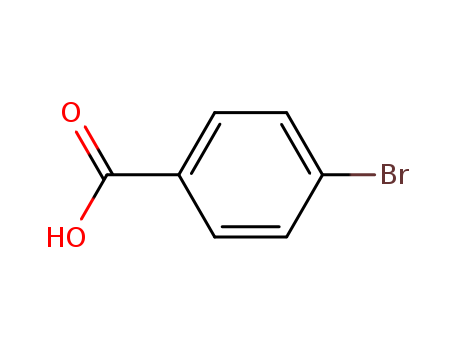
586-76-5
- Product Name:4-Bromobenzoic acid
- Molecular Formula:C7H5BrO2
- Purity:99%
- Molecular Weight:201.019
Product Details
pd_meltingpoint:252-254 °C(lit.)
Appearance:White to light yellow crystal powder
Purity:99%
Reliable Quality 4-Bromobenzoic acid 586-76-5 Hot Sale with Chinese Manufacturer
- Molecular Formula:C7H5BrO2
- Molecular Weight:201.019
- Appearance/Colour:White to light yellow crystal powder
- Vapor Pressure:0.000519mmHg at 25°C
- Melting Point:252-254 °C(lit.)
- Refractive Index:1.608
- Boiling Point:299.8 °C at 760 mmHg
- PKA:3.96(at 25℃)
- Flash Point:135.1 °C
- PSA:37.30000
- Density:1.701 g/cm3
- LogP:2.14730
4-Bromobenzoic acid(Cas 586-76-5) Usage
|
Synthesis Reference(s) |
Synthetic Communications, 17, p. 457, 1987 DOI: 10.1080/00397918708063924Tetrahedron Letters, 18, p. 4631, 1977 |
|
Reactivity Profile |
Carboxylic acids donate hydrogen ions if a base is present to accept them. They react in this way with all bases, both organic (for example, the amines) and inorganic. Their reactions with bases, called "neutralizations", are accompanied by the evolution of substantial amounts of heat. Neutralization between an acid and a base produces water plus a salt. Carboxylic acids with six or fewer carbon atoms are freely or moderately soluble in water; those with more than six carbons are slightly soluble in water. Soluble carboxylic acid dissociate to an extent in water to yield hydrogen ions. The pH of solutions of carboxylic acids is therefore less than 7.0. Many insoluble carboxylic acids react rapidly with aqueous solutions containing a chemical base and dissolve as the neutralization generates a soluble salt. Carboxylic acids in aqueous solution and liquid or molten carboxylic acids can react with active metals to form gaseous hydrogen and a metal salt. Such reactions occur in principle for solid carboxylic acids as well, but are slow if the solid acid remains dry. Even "insoluble" carboxylic acids may absorb enough water from the air and dissolve sufficiently in 4-Bromobenzoic acid to corrode or dissolve iron, steel, and aluminum parts and containers. Carboxylic acids, like other acids, react with cyanide salts to generate gaseous hydrogen cyanide. The reaction is slower for dry, solid carboxylic acids. Insoluble carboxylic acids react with solutions of cyanides to cause the release of gaseous hydrogen cyanide. Flammable and/or toxic gases and heat are generated by the reaction of carboxylic acids with diazo compounds, dithiocarbamates, isocyanates, mercaptans, nitrides, and sulfides. Carboxylic acids, especially in aqueous solution, also react with sulfites, nitrites, thiosulfates (to give H2S and SO3), dithionites (SO2), to generate flammable and/or toxic gases and heat. Their reaction with carbonates and bicarbonates generates a harmless gas (carbon dioxide) but still heat. Like other organic compounds, carboxylic acids can be oxidized by strong oxidizing agents and reduced by strong reducing agents. These reactions generate heat. A wide variety of products is possible. Like other acids, carboxylic acids may initiate polymerization reactions; like other acids, they often catalyze (increase the rate of) chemical reactions. |
|
Health Hazard |
ACUTE/CHRONIC HAZARDS: Explodes above its melting point. |
|
Purification Methods |
Crystallise the acid from MeOH, or MeOH/water mixture, 90% EtOH and Et2O. The methyl ester has m 81o from Et2O or dilute MeOH. The anilide has m 197o (from EtOH). [Male & Thorp J Am Chem Soc 35 269 1913, Lamneck J Am Chem Soc 76 406 1954, Vandenbelt et al. Anal Chem 26 926 1954, Beilstein 9 IV 1017.] |
|
Production Methods |
4-Bromobenzoic Acid is synthesized from 4-bromotoluene or benzoic acid through esterification and hydrazide formation, among other reactions. |
|
Definition |
ChEBI: A bromobenzoic acid carrying a single bromo subsituent at the 4-position. |
|
General Description |
Colorless to red crystals. |
InChI:InChI=1/C7H5BrO2/c8-6-3-1-5(2-4-6)7(9)10/h1-4H,(H,9,10)
586-76-5 Relevant articles
Selective conversion of aldehydes to carboxylic acids by hemoglobin and air
Hajimohammadi, Mahdi,Verjani, Maryam Khalaji,Ghasemi, Hoda,Safari, Nasser,Kn?r, Günther
, p. 679 - 685 (2018)
A new green, environmentally friendly an...
-
Kleene
, p. 2883 (1940)
-
Mesoporous silica-supported Pd catalysts: An investigation into structure, activity, leaching and heterogeneity
Webb, Jonathan D.,MacQuarrie, Stephanie,McEleney, Kevin,Crudden, Cathleen M.
, p. 97 - 109 (2007)
Mesoporous silica functionalized by merc...
Formation, Oxidation, and Fate of the Breslow Intermediate in the N-Heterocyclic Carbene-Catalyzed Aerobic Oxidation of Aldehydes
Bortolini, Olga,Chiappe, Cinzia,Fogagnolo, Marco,Massi, Alessandro,Pomelli, Christian Silvio
, p. 302 - 312 (2017)
The reaction paths and intermediate stru...
Experimental and theoretical studies of (4?+?1) annulations between α-oxoketenes and stable phosphorous, nitrogen, or sulfur ylides
Pierrot, David,Rajzmann, Michel,Carissan, Yannick,Rodriguez, Jean,Bonne, Damien,Coquerel, Yoann
, (2019)
α-Oxoketenes generated in situ by a micr...
Palladium(II) complex of an organotellurium ligand as a catalyst for Suzuki Miyaura coupling: Generation and role of nano-sized Pd3Te 2
Rao, Gyandshwar Kumar,Kumar, Arun,Singh, Mahabir Pratap,Singh, Ajai K.
, p. 1 - 6 (2014)
Organotellurium ligand (L = (C6H5)(2-HOC...
Synthesis, catalytic activity, and leaching studies of a heterogeneous Pd-catalyst including an immobilized bis(oxazoline) ligand
Gruber-Woelfler,Radaschitz,Feenstra,Haas,Khinast
, p. 30 - 40 (2012)
The synthesis and characterization of a ...
ROMP-spheres: A novel high-loading polymer support using cross metathesis between vinyl polystyrene and norbornene derivatives
Barrett, Anthony G. M.,Cramp, Susan M.,Roberts, Richard S.
, p. 1083 - 1086 (1999)
(matrix presented) The preparation of a ...
Transformation of Thioacids into Carboxylic Acids via a Visible-Light-Promoted Atomic Substitution Process
Fu, Qiang,Liang, Fu-Shun,Lou, Da-Wei,Pan, Gao-Feng,Wang, Rui,Wu, Min,Xie, Kai-Jun
supporting information, p. 2020 - 2024 (2022/03/31)
A visible-light-promoted atomic substitu...
Disproportionation of aliphatic and aromatic aldehydes through Cannizzaro, Tishchenko, and Meerwein–Ponndorf–Verley reactions
Sharifi, Sina,Sharifi, Hannah,Koza, Darrell,Aminkhani, Ali
, p. 803 - 808 (2021/07/20)
Disproportionation of aldehydes through ...
Amide Bond Formation via Aerobic Photooxidative Coupling of Aldehydes with Amines Catalyzed by a Riboflavin Derivative
Hassan Tolba, Amal,Krupi?ka, Martin,Chudoba, Josef,Cibulka, Radek
supporting information, p. 6825 - 6830 (2021/09/11)
We report an effective, operationally si...
Aerobic oxidation of aldehydes to carboxylic acids catalyzed by recyclable ag/c3 n4 catalyst
Wu, Chaolong,Yao, Xiaoquan,Yu, Min,Zhou, Li,Zhu, Li
, p. 167 - 175 (2021/03/19)
The oxidation of aldehydes is an efficie...
586-76-5 Process route
-

-
109-72-8,29786-93-4
n-butyllithium

-

-
60-29-7,927820-24-4
diethyl ether
-

-
19719-72-3
bis-(4-bromo-phenyl)-mercury

-
-
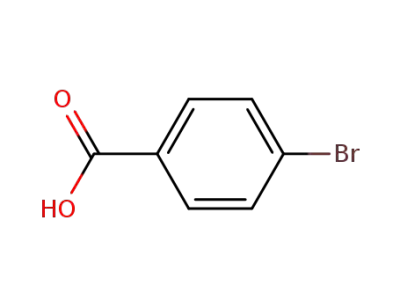
586-76-5
4-Bromobenzoic acid
-
-
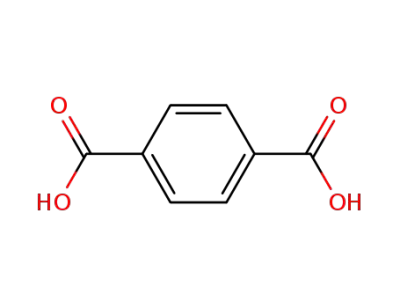
100-21-0
terephthalic acid
| Conditions | Yield |
|---|---|
|
folgende Behandlung mit CO2;
|
-
-
109-72-8,29786-93-4
n-butyllithium
-

-
106-37-6
1.4-dibromobenzene
-
-
586-76-5
4-Bromobenzoic acid
-
-
100-21-0
terephthalic acid
| Conditions | Yield |
|---|---|
|
With
diethyl ether;
Behandeln des Reaktionsgemisches mit 1.4-Dibrom-benzol und anschliessendes Behandeln mit festem Kohlendioxid;
|
586-76-5 Upstream products
-
67-56-1
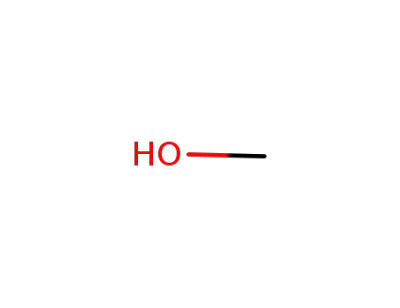
methanol
-
78271-77-9

3-(4-bromophenyl)-2-methyl-3-oxopropanenitrile
-
109-72-8
n-butyllithium
-
60-29-7
diethyl ether
586-76-5 Downstream products
-
619-42-1

4-methoxycarbonylphenyl bromide
-
6939-93-1
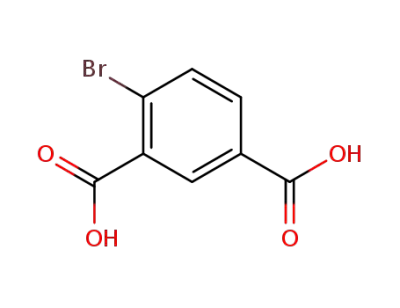
4-bromo-isophthalic acid
-
586-75-4

4-chlorobenzoyl chloride
-
5798-75-4
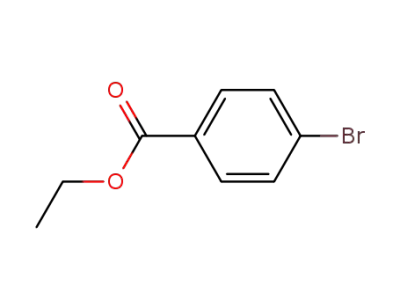
Ethyl 4-bromobenzoate
Relevant Products
-
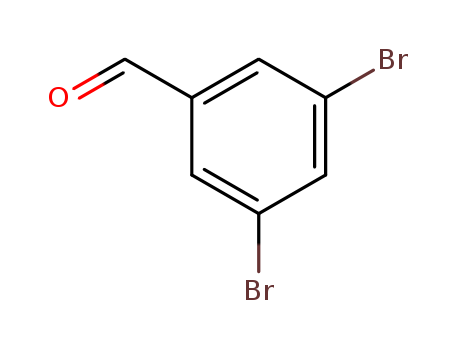 3,5-Dibromoanthranilaldehyde
CAS:56990-02-4
-
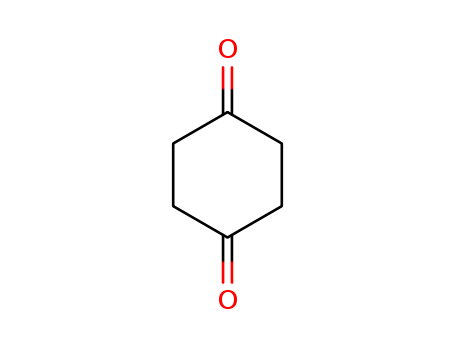 1,4-Cyclohexanedione
CAS:637-88-7
-
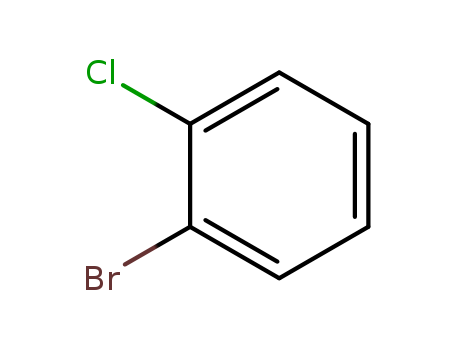 2-Chlorobromobenzene
CAS:694-80-4
